Virtual
Consult

Our Blog

Invisalign Teen®: What Parents Should Know

September 29th, 2021

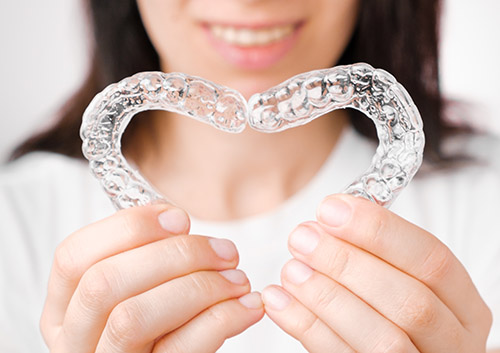
Invisalign Teen is one the newer styles of braces, and perfect for those who do not like the standard metal braces. They are available in a clear material that is practically invisible called aligners that are replaced every two weeks. The aligners are custom made for each patient and gradually straighten teeth without all of the metal and rubber bands that come with traditional braces.

Is Invisalign as effective?

If your child will wear them as directed to, then the answer is yes, they are as effective as traditional metal braces. However, to make sure the child is actually wearing them correctly you will notice a small blue spot on the back of each aligner. This is called an indicator and if worn correctly will fade over a period of two weeks. Dr. Neil Oliveira and Dr. Derek Wolkowicz will be able to tell if the patient is not wearing them correctly.

Can Invisalign be removed?

Parents should be aware that the Invisalign aligners can be removed for up to four hours per day to eat, brush teeth, play sports, or play musical instruments. With the option of removing them it actually makes brushing and flossing easier and helps oral hygiene. The recommended time to wear them is at least 20 hours per day.

How long does treatment take and what is the cost?

Your teen will wear Invisalign as long as traditional braces. However, each patient is different so you should speak with Dr. Neil Oliveira and Dr. Derek Wolkowicz to determine how many months your child can expect to wear them.

The cost is also very similar to other traditional braces; however there is no set fee. The cost will depend on your child’s unique orthodontic need.

Overall Success

Invisalign Teen has had remarkable success because patients are happy to have the option of having clear aligners for treatment. With the child more confident they are actually more prone to keep up with their treatment and many do complete their treatment sooner. You should speak with Dr. Neil Oliveira and Dr. Derek Wolkowicz as soon as possible to learn about the benefits of Invisalign Teen.

At what age should my child have an orthodontic evaluation?

September 22nd, 2021

You may have noticed that kids seem to be getting braces and other orthodontic care a lot earlier these days. There was a time, only a decade or two ago, when braces were mainly seen on teenagers, but that is beginning to change. If you’re wondering when to bring your child to our New Bedford or Mattapoisett, MA office for an orthodontic evaluation, the answer actually has several parts.

The Telltale Signs

If your child has a very crowded set of adult teeth coming in, or if the permanent front teeth came in very early, these are signs that your child should see Dr. Neil Oliveira and Dr. Derek Wolkowicz, regardless of age.

The Dental Age

Barring signs of trouble or early adult teeth as mentioned above, the time that your child needs to be seen for initial orthodontic evaluation depends not so much upon your child’s actual age, but on what is known as a “dental age.”

The dental age of the patient might be entirely different from his or her actual chronological age; for example, an eight-year-old could have a dental age of 13. It is part of Dr. Neil Oliveira and Dr. Derek Wolkowicz and our staff’s job to determine the dental age and then make appropriate recommendations for the resolution of orthodontic issues if they are emerging.

The Official Recommended Age

The American Association of Orthodontists officially recommends that kids should see an orthodontist for the first time between the ages of seven and nine. Even if the child does not have all his or her permanent teeth, the teeth growth pattern can usually be predicted quite effectively by an orthodontist.

This allows for a proactive response to emerging problems, and this is the reason that some younger children are now getting orthodontic devices earlier in life. If a young child has serious orthodontic issues emerging, Dr. Neil Oliveira and Dr. Derek Wolkowicz can usually address the problems immediately and then follow up with another round of treatment when the child has all the adult teeth.

The Invisalign® Treatment Process

September 15th, 2021

Invisalign is gaining traction as a sought-after solution for orthodontic problems. Unlike traditional braces, which require the placement of brackets on teeth and the connection of unsightly wires, Invisalign works nearly invisibly (as its name suggests). Particularly for those who do not wish to draw attention to their orthodontic work, Invisalign provides an attractive solution.

Consultation with a Treatment Provider

Our practice has received specialized training to work with Invisalign. During your consultation appointment, Dr. Neil Oliveira and Dr. Derek Wolkowicz will assess your smile needs. In some cases, the type of problem may not lend itself to correction through Invisalign, and we may offer an alternative solution.

Creation of a Custom Treatment Plan

Invisalign works using a series of customized clear trays that fit almost perfectly over the teeth. To create these trays, Dr. Neil Oliveira and Dr. Derek Wolkowicz will take X-rays and impressions of your teeth. These are submitted to a specialized laboratory that makes a 3D image of your smile. This is used to create a specialized treatment plan that provides an estimate of how long treatment will take.

Arrival of Custom Trays

Once your customized trays have arrived, the treatment begins. For Invisalign to work properly, you must wear the aligners 20 to 22 hours per day, removing them only to eat, drink, and brush your teeth. The trays gently draw your teeth into proper alignment, correcting your orthodontic problems as you go about your everyday life.

In general, you will replace your aligners with a new set every two weeks. This is to encourage your teeth to continue moving throughout the treatment process. You’ll need to check in with our New Bedford or Mattapoisett, MA office every six weeks or so to ensure treatment progresses smoothly.

Beautiful Smile: Complete!

Once you complete your individualized treatment plan, you’ll have the smile you’ve always dreamed of. Like with traditional braces, Dr. Neil Oliveira and Dr. Derek Wolkowicz may recommend that you wear a retainer to ensure that your teeth remain in their new positions.

How do braces move my teeth?

September 8th, 2021

Great question! Tooth movement is your body’s natural response to light pressure applied by braces over a period of time (usually two years). Braces work by using brackets that are glued onto your teeth; these brackets have small slots, and that is where Dr. Neil Oliveira and Dr. Derek Wolkowicz and our team insert orthodontic wires. These wires are held in place by small elastic ties that fit around the brackets. As time passes during your treatment, these wires apply pressure on your teeth, which sets in motion the movement of your teeth into their desired positions. Each of your teeth has a different size and shape to them, as do the brackets. Each bracket is custom-made for the particular tooth on which it’s supposed to fit.

Not long ago, orthodontists had stainless steel wires and that was about it. Today, however, we have a number of different high-tech wires at our disposal to move your teeth faster and more comfortably.

When you first get your braces on, the first wire or two will typically be very flexible, but still strong enough to apply a constant force on your teeth. As your teeth straighten out over time, however, Dr. Neil Oliveira and Dr. Derek Wolkowicz will use progressively thicker and firmer wires to help move your teeth in place for an ideal bite.

Every time you visit our office for an adjustment, we will swap out the wires in order to keep putting pressure on your teeth, which is why it’s so important for you to keep your adjustment visits during your treatment. Most adjustment appointments are scheduled four to eight weeks apart to give your teeth time to move.

As for rubber bands and elastics, most of our patients will need to wear elastics or rubber bands at some point during their treatments. These elastics typically go from one or more of the upper braces to one or more of the lower braces, and pull on your teeth to move them in the direction they need to move in order to achieve an optimal bite.

If you have any questions about wires, brackets, or elastics, or have any general questions about your treatment, please give us a call at our New Bedford or Mattapoisett, MA office.